I've managed a lot of designers over the years, and I’ve found myself giving the same feedback repeatedly to almost all of them at some point:
“I need you to be more opinionated with your work. When you share your work, I want to hear what your POV is about the different design directions.”
And every time I give them this feedback, I get the same answer:
"But I don’t want to bias other people’s opinions."
It’s clear to me that this is a common fear, and it prevents people from forcing themselves to either form their own opinions or share ones they have. However, the truth is, that sharing your opinion on the work you've created is actually incredibly important for your growth and for the work.
Here’s why sharing your opinion is so important:
- It sharpens critical thinking: Forcing yourself to form an opinion requires mapping design options to project and business goals, which brings clarity to your decision-making. Articulating your POV helps you spot flaws in your logic—something that’s happened to me many times. When I shared this piece with my team, one of my designers told me she’s internalized the idea that sharing your opinion is “a way of helping us narrow in on the solution more efficiently,” and that’s why the practice sticks with her.
- It strengthens communication skills: Concisely and clearly articulating a POV is a muscle you must build, and it strengthens with practice. As you grow, teams will expect you to lead with an opinion while still leaving room for collaborative discussion.
- It helps focus the conversation: If you're sharing a bunch of different design directions, people can sometimes be all over the place with their feedback. But if you can start the conversation by pointing out which direction is going to be more successful for users, the discussion is naturally going to be more focused and fruitful.
- It helps you build confidence: By getting in more reps with more focused critical thinking, it helps you strengthen your own decision making skills, therefore building confidence as a designer.
- It helps teach others: Designers learn from other designers talking about design. That's a bit of a mouthful, but it's true. A more inexperienced designer is going to learn how to form and talk about their opinions by watching a more senior designer share their opinions.
This advice is not only relevant to designers and sharing opinions on design direction. It’s important to share your opinion about the work you’re doing no matter what type of work it is. This could apply to PMs who are weighing different scoping options, or it could apply to engineers who are weighing different technical solutions.
Here are a few tips on how to share your opinion:
- Explain what’s successful, and why. Always tie the “why” back to your user/business goals.
- Be prepared to explain what you tried that didn’t work (and why!). It’s not always necessary to proactively elaborate on all discarded options.
- Share what remaining open questions you have.
- Talk about anything that you’re still exploring.
- Always be open to feedback, even if you can’t incorporate it right away.
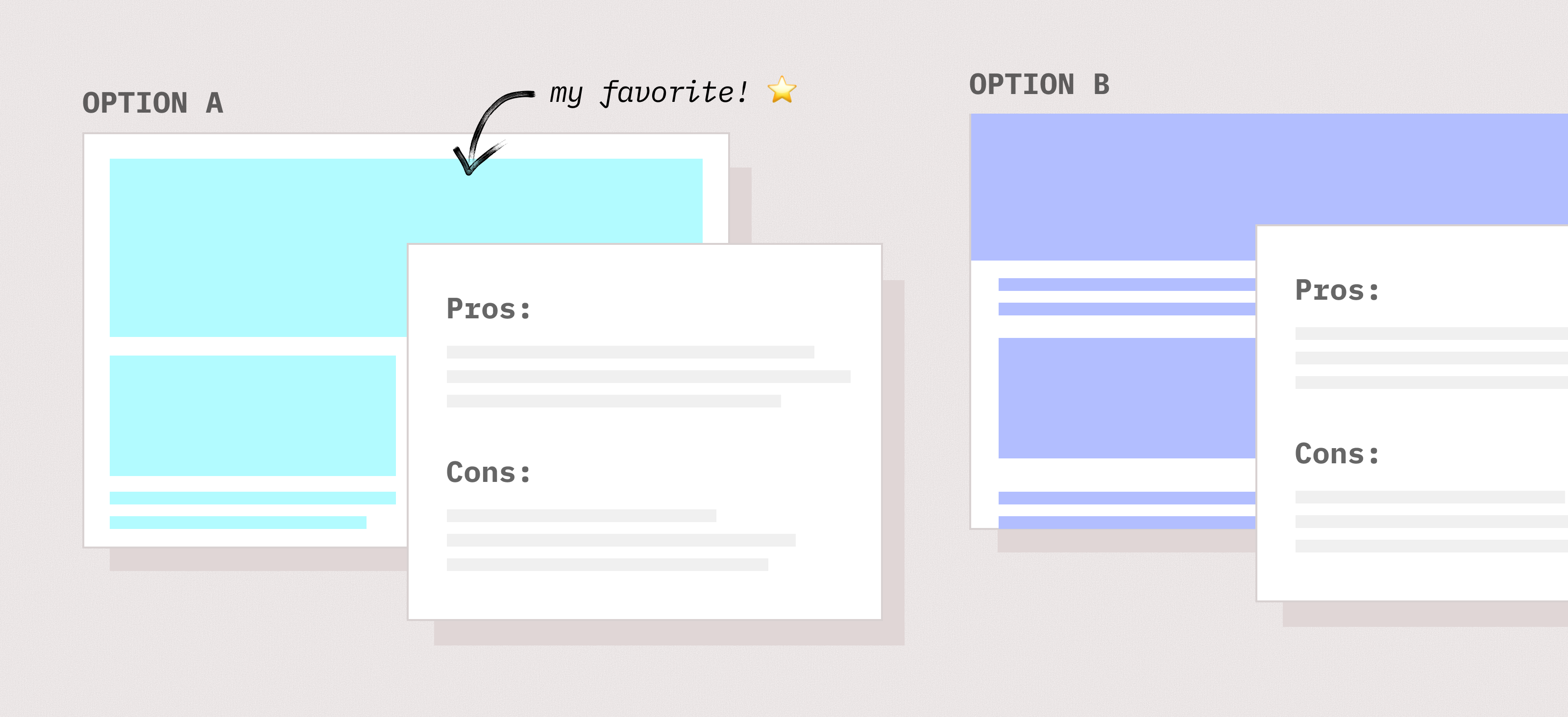
A good way to start practicing this is to make a little scribble area next to each artboard in Figma (if you’re not in Figma, find an easy place to write down your thoughts!), and outline the pros and cons of each option. Once you have those all laid out, it’ll be easier to choose which option(s) are most successful.
So, next time you’re worried about biasing other people by sharing your opinion, don't think twice about it. It's going to help you, it's going to help the work, and it's going to help others.